Launch of Computing Power “Supermarket” on Trading Centers: How Computing & Data Vouchers Reduce Costs and Improve Efficiency for AI Agent Applications
English Version
In July 2026, Jiangxi Province officially launched its Computing Power Scheduling Service Platform, with the innovative “Computing Supermarket” module officially going online. In the same month, the China Academy of Information and Communications Technology (CAICT) initiated the “Computing Power Super Bank Ecological Co-construction Plan” together with industrial partners. As early as April 2026, the Ministry of Industry and Information Technology explicitly proposed exploring innovative business models such as “computing power banks” and “computing power supermarkets” in the special action policy for empowering SMEs with inclusive computing power.
The “computing power supermarket” is no longer a conceptual prototype but a fully landed industrial service model. As early as March 2025, Hangzhou launched its integrated computing power scheduling platform, integrating core functions including a computing power supermarket, large model aggregation, computing power matching transactions, and voucher application. By May 2026, its cumulative transaction volume had exceeded 200 million RMB. In 2023, China’s first green computing power supermarket opened in Horinger New District, Hohhot, Inner Mongolia. Meanwhile, Shanghai’s “Model Speed Space” released the country’s first comprehensive “computing power ecological supermarket”, paving the way for standardized and popularized AI infrastructure services nationwide.
The industrial logic has undergone a fundamental shift: computing power is evolving from idle hardware in computer rooms to standardized, purchasable commodities on supermarket shelves.
Computing Power Supermarket: Transforming From Hardware Procurement to Service Subscription
The traditional computing power acquisition model has long been unfriendly to SMEs. Traditional deployment requires purchasing physical servers, building operation environments, and signing long-term exclusive contracts, with initial investment costs starting at millions of RMB, forming a high threshold for SME AI transformation.
The emerging computing power supermarket completely reverses this model. It supports one-stop online query and purchase of diversified AI resources including computing power, Tokens, large models and datasets. Enterprises can flexibly select customized “computing + data” combined packages according to business demands, realizing an online shopping-style lightweight service experience.
Jiangxi’s newly launched Computing Supermarket has completed the deployment of core functional modules, including a unified service portal, full-dimensional computing power monitoring and scheduling, and policy implementation for computing & data vouchers. Adhering to the service logic of “on-demand access, cross-cycle scheduling and credit empowerment”, the platform frees enterprises from underlying hardware configuration and technical operation burdens. Users only need to pay according to actual AI capability consumption, just like daily mobile traffic billing.
The shift from “purchasing physical hardware” to “subscribing cloud services” marks a critical inflection point in the industrial upgrading of AI infrastructure.
Dual Empowerment of Computing & Data Vouchers: Structural Cost Reduction for AI Agent Development
If the computing power supermarket solves the problem of convenient procurement of AI resources, computing vouchers and data vouchers fundamentally solve the problem of affordable usage for SMEs.
Wuhu City took the lead nationwide in launching the linkage mechanism of “computing vouchers + data vouchers + model vouchers”. The municipal government arranges an annual special subsidy fund of up to 100 million RMB, enabling enterprises to reduce their comprehensive computing costs by a maximum of 50%. To date, the total value of issued triple vouchers has exceeded 40 million RMB, leveraging nearly 400 million RMB in market computing transactions with an outstanding industrial leverage ratio.
The policy adopts tiered differentiated subsidies: ordinary enterprises can get a voucher rebate of 25% of actual intelligent computing service expenses; enterprises engaged in future industries such as embodied intelligence enjoy an increased rebate ratio of 45%; SMEs settled in the local “Computing Cube” platform can obtain the highest rebate ratio of 70%, maximizing inclusive benefits.
Jiangxi’s computing and data vouchers are targeted policy tools for SMEs, supporting the rental of advanced computing resources and the procurement of data products and services. Qualified enterprises can get a proportional subsidy based on actual consumption, with a maximum subsidy ratio of 20% and an annual cumulative subsidy cap of 1 million RMB per entity.
Guizhou’s voucher policy has iterated to Version 3.0, expanding the incentive scope to model services and data services for the first time, offering a 30% subsidy on effective contract amounts for relevant service purchases.
Superimposed with multiple policy dividends, the cost structure of AI Agent development has been comprehensively optimized. China Unicom’s Yuanjing Tianrong Agent Supermarket introduces precise Token metering and pay-as-you-go billing, reducing overall Agent development costs by approximately 50%. For a 50-person small manufacturing enterprise deploying a basic AI Agent system covering order processing, financial reconciliation and customer service response, the monthly technical operation cost is only 2,500 to 4,000 RMB after superimposing public cloud computing resources and inclusive subsidies.
The triple voucher linkage forms a complete cost-reduction closed loop: computing vouchers cut underlying computing access costs, data vouchers lower the threshold of data element application, and model vouchers reduce model development and invocation expenses. The multi-dimensional superposition effect has turned enterprise AI Agents from “luxury tools for large corporations” into “affordable productivity tools for SMEs”.
From General Vouchers to Token Vouchers: Refined, Scenario-Oriented Policy Empowerment
Regional subsidy policies are continuously iterating and refining, shifting from generalized computing subsidies to precise Token and Agent-oriented subsidies. Beijing encourages qualified districts and innovation institutions to jointly launch Token vouchers and intelligent agent service vouchers. Yangzhou has become the first city in Jiangsu to introduce special Token voucher policies, forming a three-dimensional support system coordinated with computing and data vouchers.
Jiang’an District of Wuhan allocates 10 million RMB of special funds annually for Token vouchers and computing vouchers respectively, with a maximum annual subsidy of 300,000 RMB for a single enterprise. Shandong Province jointly issued policies across 12 departments, launching computing vouchers for cloud deployment cost reduction, corpus vouchers for data threshold reduction, and model vouchers for development difficulty reduction, covering the full AI industrial chain.
Liu Liehong, Director of the National Data Administration, officially defined Tokens as “the value anchor of the intelligent era and the core settlement unit connecting technical supply and commercial demand”. The official recognition of Token’s value status has laid a solid institutional foundation for the large-scale implementation of Token voucher policies.
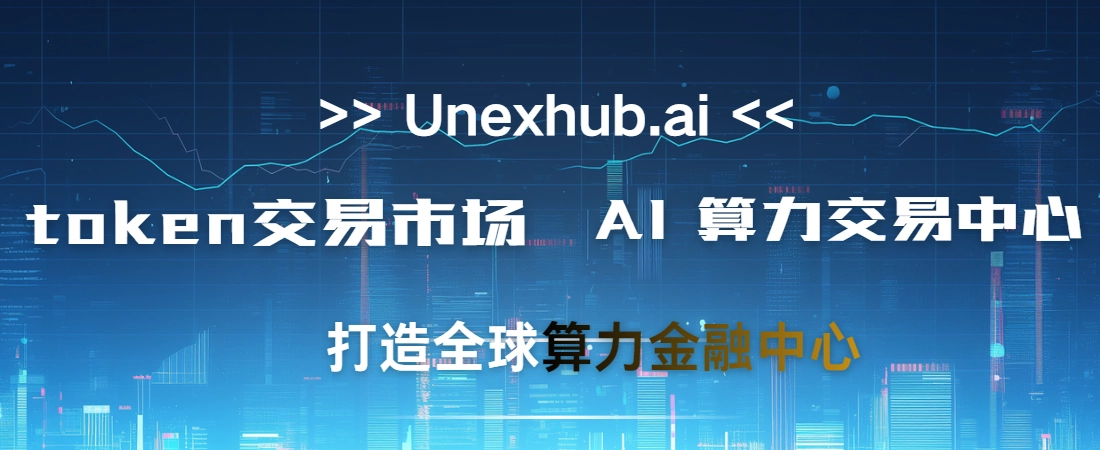
Unexhub: Realizing Commoditized Trading of Global Tokens
Local computing power supermarkets focus on retail service of AI resources to meet enterprises’ flexible on-demand procurement needs. As a global Token aggregation and distribution trading center, Unexhub complements the industrial chain by solving the wholesale and circulation pain points of Token resources, building a complete market trading system.
Unexhub’s three core mechanisms bring tangible benefits to both resource suppliers and developer users:
Real-Time Full Settlement: It completely solves the long-term cash flow dilemma of small and medium-sized computing suppliers. Token supply volume and capital return are synchronized in real time, eliminating capital occupation and corporate financial pressure.
Permanent Zero Commission for Early Settled Merchants: Early cooperative suppliers enjoy a zero-platform-commission privilege, directly cutting the largest operational cost and greatly improving profit margins.
Dynamic API Bidding Mechanism: API invocation prices float intelligently with market supply and demand, adopting a peak-valley pricing model similar to power grids. Individual developers obtain ultra-low-price resources during off-peak periods, while suppliers gain premium returns during demand peaks to maximize resource utilization efficiency.
Local computing power supermarkets act as “Token retail stores” for inclusive services, while Unexhub serves as a professional “Token exchange” for industrial circulation. Both paths verify the core trend: Tokens have become the most fundamental pricing unit and trading asset in the AI era.
Industry Insight & Future Trend
The industrial development context is extremely clear: computing power supermarkets make computing power accessible, computing vouchers make computing power affordable, data vouchers make data elements usable, Token vouchers make Token consumption cost-effective, and Unexhub makes Token resources circulatable. The five-dimensional system jointly suppresses the comprehensive deployment cost of AI Agent applications in a systematic manner.
Industrial data fully proves the practical value of the model: Wuhu’s triple voucher policy leverages 10 RMB of market transactions per 1 RMB of fiscal subsidy; China Unicom’s Agent supermarket halves enterprise AI development costs. Cost reduction and efficiency improvement are no longer empty slogans, but quantifiable and verifiable industrial results.
It is worth noting that the industry still has room for iteration: voucher quotas are limited with fixed redemption cycles, and the sustainability of Unexhub’s bidding model depends on market liquidity and supplier participation willingness. The subsidy-driven initial market will eventually evolve into a fully market-oriented mature market.
Nevertheless, the general trend is irreversible: computing power is transforming from a niche luxury resource to universal public infrastructure. With the popularization of computing supermarkets, inclusive vouchers and Token market transactions, the large-scale landing of SME-oriented AI Agent applications is no longer a technical question, but an inevitable industrial result.
Unexhub reshapes global Token trading logic and builds a one-stop Token aggregation and distribution computing power trading center. The platform gathers full-spectrum AI suppliers, covering top large models such as Gemini, ChatGPT, Claude, DeepSeek and GLM, as well as high-quality customized models from individual developers and SMEs. Relying on millisecond-level intelligent routing, massive AI resources participate in open bidding, bringing ultra-low-cost services to enterprise users and developers.
Developers pay strictly based on actual Token consumption and can enjoy a minimum discount of 30% off market prices. Suppliers can access the platform with one click to open diversified sales channels and realize real-time settlement of invocation revenue shares.
中文版本
2026年7月,江西省算力调度服务平台正式上线,旗下创新模块「算数超市」同步亮相、投入商用。同月,中国信息通信研究院联合全产业链主体,正式启动「算力超银生态共建计划」。而早在2026年4月,工信部发布的普惠算力赋能中小企业专项行动通知中,就首次明确提出探索「算力银行」「算力超市」等全新业态,为行业发展划定清晰方向。
如今,「算力超市」早已脱离概念阶段,实现全国多地落地开花。2025年3月上线的杭州算力资源调度服务平台,集成算力超市、大模型聚合、算力撮合交易、算力券申领等全链条核心功能,截至2026年5月,平台累计交易额已突破2亿元。全国首个绿色算力超市落地2023年内蒙古呼和浩特和林格尔新区,上海「模速空间」则推出全国首个算力生态超市,各地平台层层迭代,推动算力服务标准化、普惠化。
行业逻辑已然彻底革新:算力不再是机房中冰冷的硬件设备,而是摆在超市货架上、可按需选购、可灵活交易的标准化智能商品。
算数超市:从「采购硬件」到「订阅服务」的范式升级
传统算力获取模式,长期桎梏中小企业智能化发展。企业想要搭建AI体系,需自主采购服务器、部署运维环境、签订长期固定合同,前期硬件、人力、运维投入动辄数百万元,极高的启动门槛让众多中小企望而却步。
算数超市彻底颠覆传统模式,打造轻量化AI资源采购渠道。平台支持算力、词元、大模型、数据集等全品类AI资源线上查询、一键选购,企业可根据自身业务需求,自由搭配「算力+数据」定制组合包,实现网购式便捷采购,无需额外投入底层基建。
江西全新上线的算数超市,已完成统一服务门户、全域算力监测调度、算力券&数据券政策落地等核心模块搭建。平台秉持「按需接入、跨期调度、信用赋能」的轻量化服务模式,企业无需关注芯片型号、硬件配置等底层技术细节,无需承担运维成本,如同日常充值流量一般,仅按实际AI能力消耗量付费。
从「采购实体硬件」到「订阅云上服务」,短短十字的转变,正是国内AI基础设施产业化升级的核心拐点。
算力券+数据券双赋能:智能体开发成本结构性下沉
算数超市解决了中小企业「算力难买、采购繁琐」的问题,而算力券、数据券的普惠落地,彻底破解「算力太贵、用不起」的核心痛点,双向助力智能体应用降本增效。
芜湖率先全国推出「算力券+数据券+模型券」三券联动政策,市级每年预留最高1亿元专项补贴资金,企业综合算力成本最高直降50%。目前三券累计发放金额超4000万元,成功撬动近4亿元算力市场交易,产业杠杆效应高达1:10,赋能效果十分显著。
政策实行差异化阶梯补贴,精准适配不同企业需求:普通企业可兑付智算服务实际费用的25%;具身智能等前沿未来产业企业,补贴比例提升至45%;入驻芜湖「算立方」平台的中小企业,补贴比例最高可达70%,最大限度释放普惠红利。
江西专属算力券、数据券,专项用于企业租用高端算力资源、采购数据产品及配套服务,按企业实际消费金额比例补贴,最高补贴比例20%,单家企业年度累计兑付金额上限100万元,精准降低企业AI研发投入。
贵州算力券政策已迭代升级至3.0版本,首次将模型服务、数据服务纳入补贴范畴,企业采购相关服务,可享受有效合同金额30%的专项补贴,进一步拓宽降本边界。
多重政策红利叠加,彻底重塑智能体开发的成本结构。中国联通元景·天融智能体超市搭载精细化词元计量、按量付费机制,可将智能体整体开发成本降低50%。以50人规模的中小型制造企业为例,部署订单处理、财务对账、智能客服一体化基础AI智能体系统,依托公有云算力叠加普惠补贴后,月度技术使用成本仅需2500-4000元,成本优势十分突出。
三券联动形成完整降本闭环:算力券压低底层算力采购成本,数据券降低数据要素获取门槛,模型券削减模型开发与调用开支。三重优势叠加,让原本只有大型企业能负担的智能体研发应用,变成中小企业可轻松落地的普惠生产力工具。
补贴精细化迭代:从通用算力补贴到专属词元补贴
各地产业补贴持续精细化、场景化升级,告别粗放式算力补贴,精准瞄准AI核心生产要素——词元与智能体。北京鼓励各区联合创新主体,落地词元券、智能体服务专项补贴;扬州成为江苏首个推出词元券专项政策的城市,构建起「算力券+数据券+词元券」三位一体的扶持体系。
武汉江岸区每年为词元券、算力券各安排1000万元专项资金,单家企业年度最高可申领30万元补贴,全程线上申报、便捷高效。山东十二部门联合发文,推出算力券减负云部署、语料券降低数据门槛、模型券简化开发难度的全链条补贴政策,覆盖AI研发全流程。
国家数据局局长刘烈宏明确界定:词元是智能时代的价值锚点,是衔接技术供给与商业需求的核心结算单位。词元获得官方权威价值定义,为全国词元券的规模化落地、标准化推广,筑牢了制度根基。
Unexhub:搭建词元市场化交易流通体系
各地算数超市主打「零售服务」,满足企业零散、按需的算力与数据采购需求;而Unexhub补齐产业短板,聚焦词元的「批发流通与市场化交易」,搭建起全球化词元聚合分发算力交易中心,完善产业闭环。
Unexhub三大核心机制,全方位赋能供需两端,激活产业活力:
实时结算,零现金流压力:彻底解决中小算力供应商前置投入、滞后回款的行业痛点,词元供应与资金回流实时同步,零资金占用、零财务周转压力。
早期入驻永久0佣金:首批入驻的算力供应商、AI生态伙伴,可享受平台永久零佣金权益,直接省去最大运营成本,大幅提升盈利空间。
API峰谷竞价,市场化动态定价:复刻电网峰谷电价逻辑,API调用价格随市场供需智能浮动。开发者低谷时段低价调用、极致控本;供应商高峰需求时段溢价增收,高效盘活闲置算力资源,实现供需最优匹配。
如果说各地算数超市是服务大众的「词元零售店」,Unexhub就是赋能产业的「词元交易所」。二者互补协同,共同印证行业核心趋势:词元已成为AI时代最基础、最核心的计价单位与交易标的。
产业总结与未来展望
纵观全产业链,行业发展脉络清晰可循:算数超市让算力买得到、用得便捷,算力券让算力成本更低、普惠可用,数据券让数据门槛消解、高效赋能,词元券让词元按量划算、物尽其用,Unexhub让词元自由流通、市场化定价。五层体系层层叠加,系统性压低智能体应用落地的综合成本。
实打实的产业数据印证降本实效:芜湖三券政策1元补贴撬动10元市场交易,杠杆效应显著;联通智能体超市直接将企业AI开发成本腰斩。降本增效不再是行业口号,而是可量化、可落地、可复制的产业成果。
客观而言,行业仍处于迭代初期,存在补贴额度有限、词元券兑付有固定周期等问题,Unexhub竞价模式的长效落地,也依托于市场流动性与供应商参与度。补贴驱动的初期市场,终将迭代为市场化自主运转的成熟生态。
但产业大势已然确定:算力正从少数企业的高端奢侈品,转变为全行业普惠的基础设施。算数超市普及、普惠券落地、词元市场化交易成型,意味着智能体规模化落地,不再是「能不能做」的问题,而是「何时全面爆发」的必然趋势。
Unexhub重塑全球Token流通交易规则,打造一站式Token聚合分发算力交易中心。平台汇聚全层级AI资源,涵盖Gemini、ChatGPT、Claude、DeepSeek、GLM等头部大厂大模型,以及个人、中小企业出品的优质定制模型。依托毫秒级智能路由技术,海量AI资源公开竞价,为企业与开发者提供极致低价的调用服务。
平台支持开发者按实际Token消耗量实付结算,最低可享市场3折超低调用价格;供应商一键入驻即可打通全域销售渠道,调用分成实时结算、快速回款,零门槛实现规模化盈利。